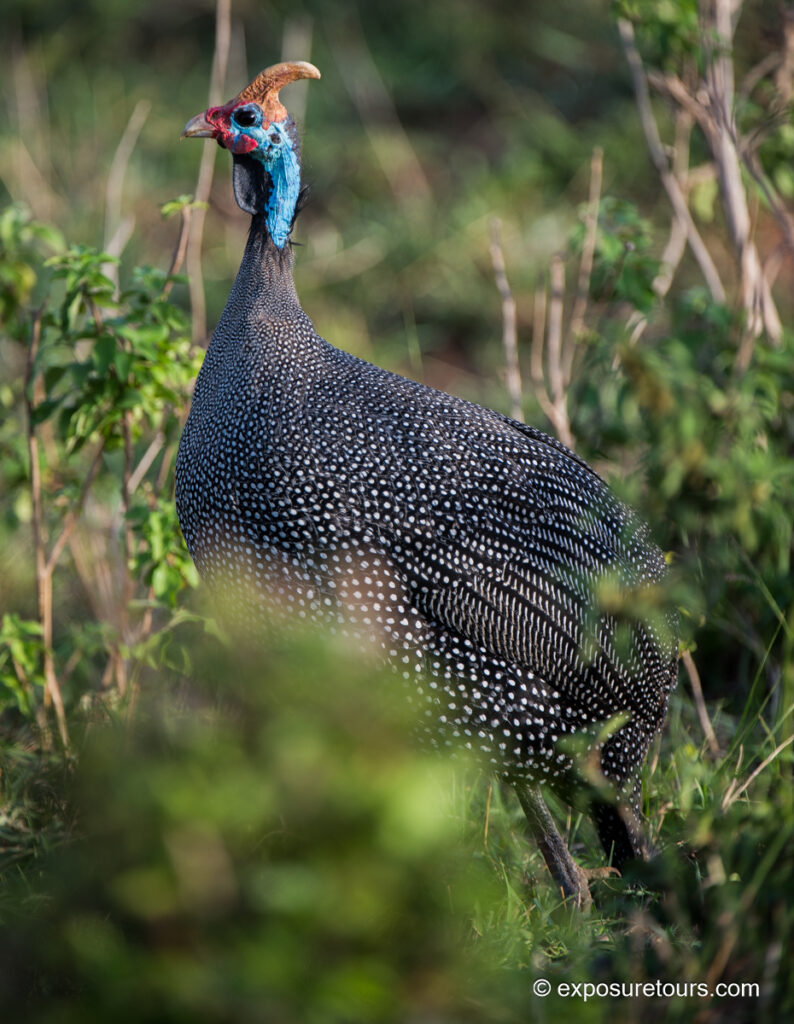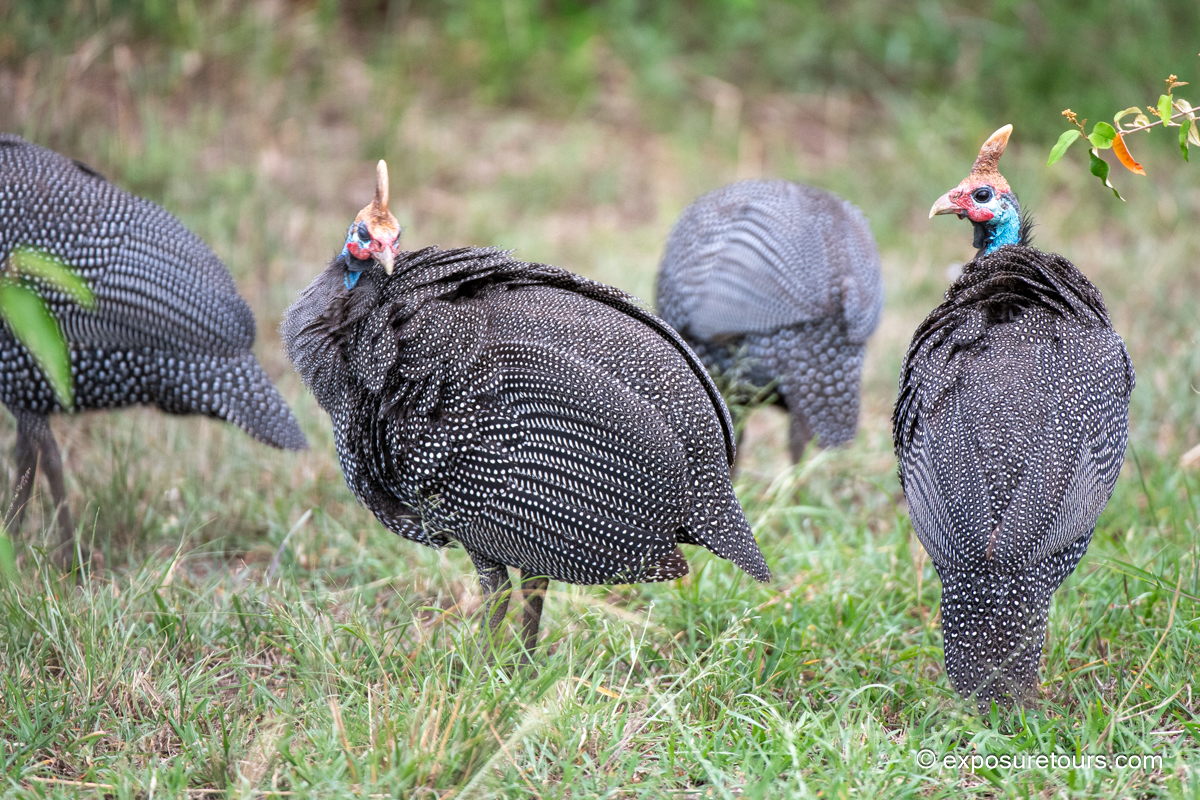
The Helmeted Guinea Fowl (Numida meleagris) is a distinctive ground-dwelling bird widely distributed across sub-Saharan Africa. It thrives in savannas, open grasslands, agricultural areas, and woodland edges. In these habitats, it actively forages in groups for seeds, insects, and small invertebrates.
You can easily recognize the species by its rounded body and striking appearance. Dark grey to black plumage, densely covered with small white spots, gives the bird its characteristic look. In addition, it displays a bare blue face, bright red wattles, and a prominent helmet-like bony casque on the head. Adults typically measure 53–63 cm (21–25 in) in length and weigh between 1.3 and 1.6 kg (2.9–3.5 lb). Although guinea fowl can produce strong, short bursts of flight, they spend most of their time walking or running on the ground. This behavior reflects their strong adaptation to a terrestrial lifestyle. They also live highly social lives, forming flocks of 10–30 individuals. Within these groups, they produce loud, harsh calls that often warn others of nearby predators.
Breeding usually coincides with the rainy season, when food becomes abundant and conditions favor raising young. The female lays a clutch of 6–12 eggs in a shallow ground nest hidden by vegetation. She incubates the eggs for approximately 26–28 days. After hatching, the chicks quickly leave the nest and follow the adults while learning to forage. The group protects and guides these precocial young, allowing them to grow rapidly. In addition, guinea fowl play an important ecological role by controlling insect populations, including ticks and other pests.
Photography Tips:
For photography, guinea fowl often allow a close approach but remain alert to movement. Move slowly and steadily to avoid disturbing them. Plan shoots for early morning or late afternoon, when the light improves and the birds forage actively across open ground. Use a medium telephoto lens in the 200–400 mm range to capture both flock behavior and individual portraits. Shoot at eye level to highlight their unique facial features and patterned plumage. Also watch for moments of interaction or alarm, as these behaviors can produce dynamic and engaging images.