
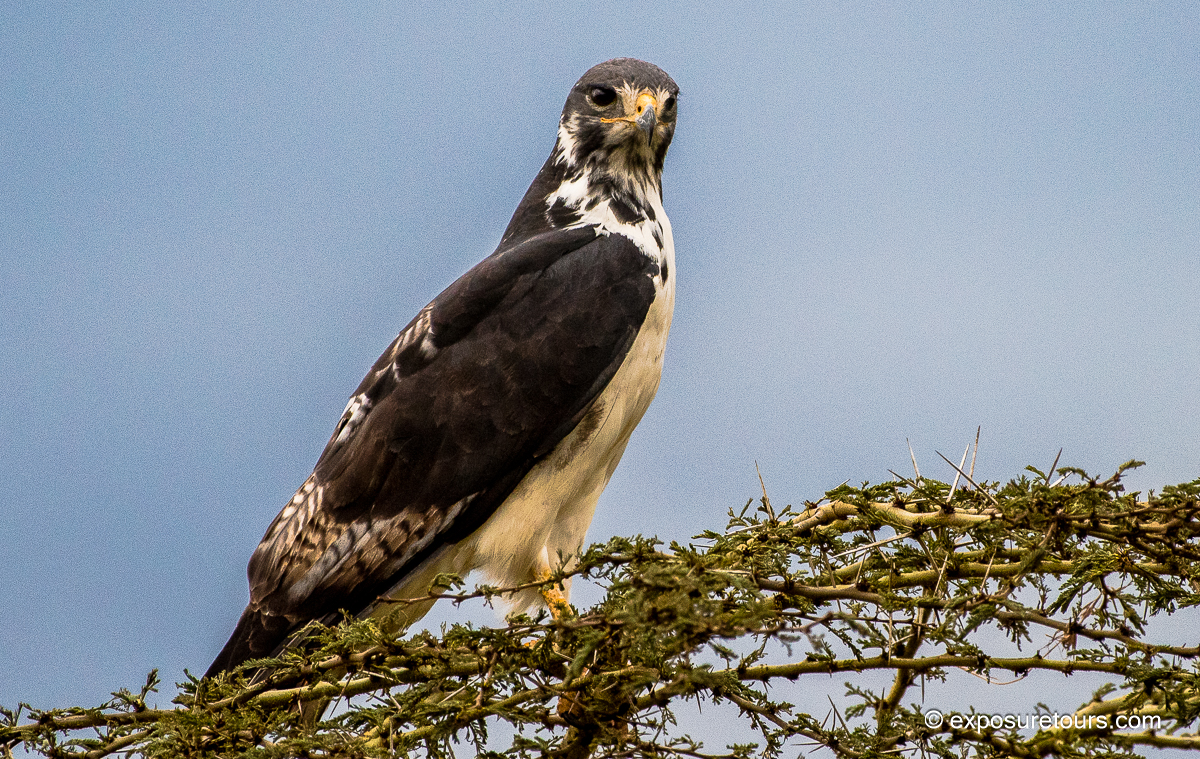
The augur buzzard (Buteo augur) is a powerful and striking bird of prey. It is commonly found across eastern and northeastern Africa. In particular, it favors open grasslands, highland plateaus, savannas, and agricultural areas. These habitats often provide elevated perches. As a result, the bird is frequently seen sitting conspicuously on trees, poles, or rocky outcrops. Adults typically measure about 55–60 cm (22–24 in) in length. They have an impressive wingspan of roughly 120–140 cm (47–55 in). In terms of weight, most individuals range between 1–1.4 kg (2.2–3.1 lb).
Females are noticeably larger than males. The species is easily recognized by its bold plumage. In adults, the rich rufous tail is especially distinctive. This contrasts strongly with the pale underside and darker flight feathers. Augur buzzards are largely solitary. They are also highly territorial. Breeding occurs at different times depending on region and altitude. Nests are built in tall trees or on cliff faces. The incubation period lasts approximately 40–45 days. During this time, the female performs most of the incubation while the male provides food.
Photography Tips:
Augur buzzards are excellent raptor subjects. This is due to their size, bold coloration, and often cooperative behavior. They frequently choose exposed perches. For this reason, they are relatively easy to locate in open landscapes. For best results, approach slowly and deliberately. Using a long telephoto lens helps minimize disturbance. Early morning light works particularly well.
It enhances facial detail and brings out the rich color of the rufous tail. As temperatures rise, augur buzzards often begin to soar. This creates strong opportunities for flight photography during mid-morning. Capturing birds in flight against clean skies or distant scenery can produce dramatic images. Paying attention to wind direction is important. Anticipating takeoff from favored perches can greatly increase your chances of successful action shots.