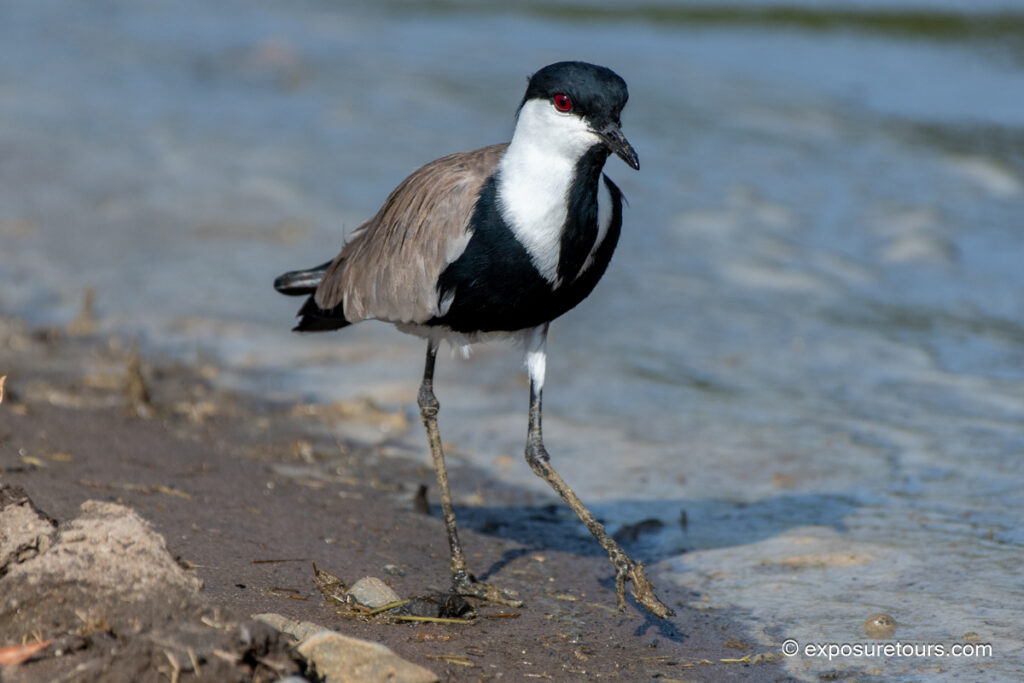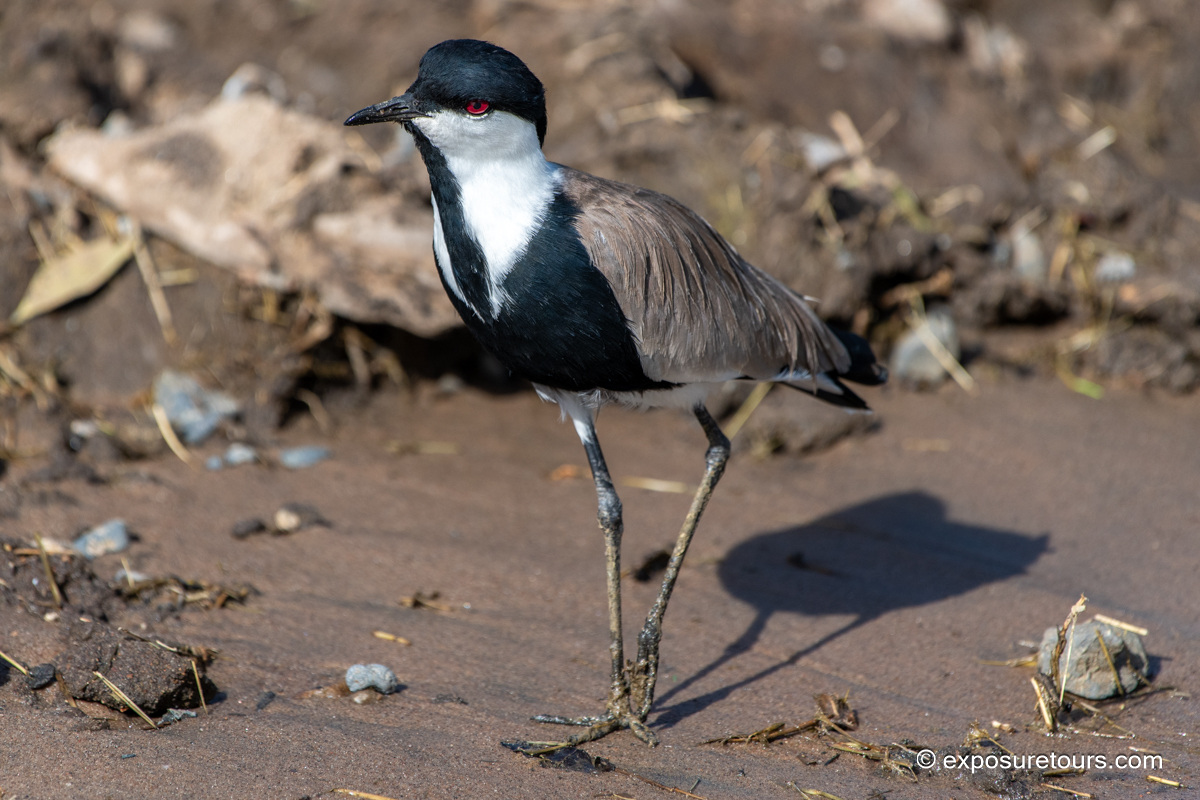
The Spur-winged Lapwing (Vanellus spinosus) is a medium-sized wading bird found throughout sub-Saharan Africa, the Nile Valley, and parts of the Middle East. It inhabits wetlands, lakeshores, riverbanks, floodplains, marshes, irrigated farmland, and open grasslands. Unlike many waders, it often feeds away from water. It searches for insects, worms, spiders, snails, and other small invertebrates in short grass and cultivated fields. Adults measure 30–32 cm (12–13 in) in length with a wingspan of 75–85 cm (30–33 in). They typically weigh 160–300 g (5.6–10.6 oz).
The species is easily recognized by its striking black-and-white plumage, long pink legs, bright red eye, and sharp black spur on each wing. This spur gives the bird its common name. It is used mainly for defense during territorial disputes. Spur-winged Lapwings are highly territorial and have loud, distinctive alarm calls. During the breeding season, they become especially aggressive. They will readily dive-bomb predators, livestock, and even humans that approach their nest.
Breeding usually coincides with the rainy season, although the timing varies by region. The pair makes a shallow scrape on bare ground instead of building a traditional nest. The scrape is often lined with small stones or pieces of vegetation. The female usually lays 3–4 heavily camouflaged eggs. Their markings help them blend perfectly with the surrounding soil. Incubation lasts about 26–30 days. Both parents share incubation duties and care for the chicks after hatching. The chicks are precocial. They leave the nest within hours and begin feeding themselves while following their parents. Throughout this period, the adults remain highly protective. They often feign injury to lure predators away from their young.
Photography Tips:
Spur-winged Lapwings are excellent wildlife photography subjects. Their bold markings and fascinating behaviour provide countless opportunities. The soft light of early morning and late afternoon enhances feather detail and reduces harsh shadows. Because they often feed in open habitats, it is usually easy to create clean backgrounds. Photographing from a low angle produces a more intimate perspective and helps blur distant grass or water.
Behavioral images are especially rewarding. Watch for territorial displays, courtship, foraging, and defensive flights around nesting areas. Use a shutter speed of 1/2500 second or faster to freeze wing movement during flight or dive-bombing displays. Continuous autofocus and high-speed burst mode will improve your chances of capturing sharp action. Always respect nesting birds. If the adults begin calling loudly or repeatedly swoop toward you, you are too close. Move back immediately to avoid disturbing the nest.